The landscape of higher education in the United States is undergoing a seismic shift. As we navigate through 2026, the traditional boundaries between “hard” and “soft” sciences are blurring. Driven by rapid advancements in artificial intelligence, a renewed focus on climate resilience, and the complexities of post-digital human behavior, students and researchers are pivoting toward interdisciplinary fields that offer both high “Information Gain” and practical career longevity.
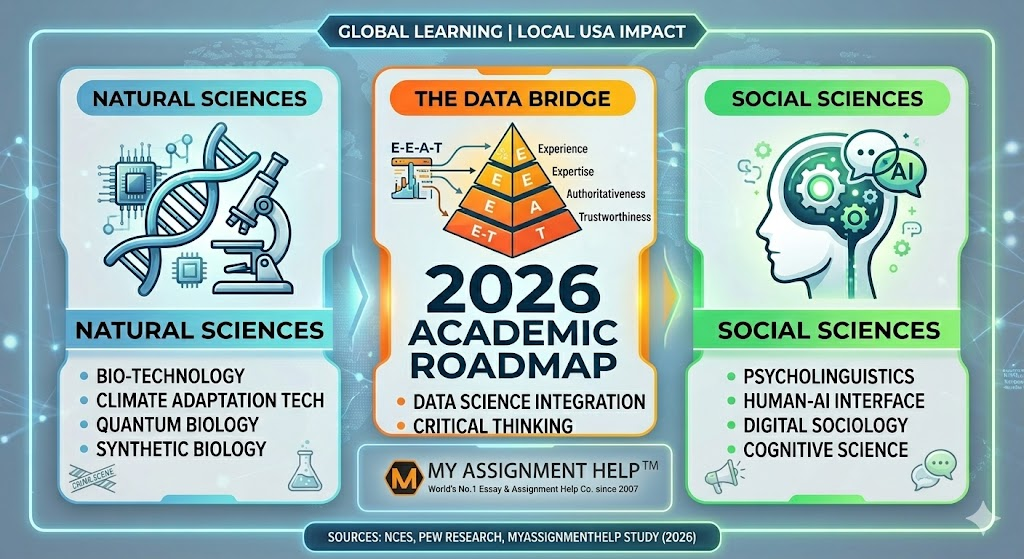
For those navigating the current academic cycle, selecting a research direction is no longer just about personal interest—it is about aligning with the evolving standards of E-E-A-T (Experience, Expertise, Authoritativeness, and Trustworthiness). This roadmap explores the dominant trends shaping research in the US for 2026.
1. Natural Sciences: The Era of Precision and Investigation
In the natural sciences, the focus has moved from broad observation to granular, tech-driven precision. We are seeing a massive surge in interest regarding biotechnology, renewable energy systems, and modern investigative sciences.
One of the most significant shifts has been in the application of data science to criminal justice. As digital footprints become more complex, the demand for rigorous methodologies has skyrocketed. Students looking to lead in this space are increasingly seeking out contemporary forensic science research topics that incorporate machine learning and advanced toxicology. This intersection of biology and technology is not just about solving cases; it’s about establishing the “Trustworthiness” required by 2026 legal and ethical standards in the US court system.
Key Trends in Natural Sciences:
- Climate Adaptation Tech: Moving beyond “prevention” to “resilience” engineering.
- Quantum Biology: Exploring non-trivial quantum effects in biological processes.
- Synthetic Biology: Designing and constructing new biological parts for healthcare.
2. Social Sciences: Decoding the Human-AI Interface
The social sciences are experiencing a renaissance. In 2026, the primary focus is understanding how humans adapt to an AI-integrated society. Sociology and psychology are no longer just looking at human-to-human interaction but are now prioritizing the “Experience” of human-to-machine communication.
A fascinating development in this sector is the rise of cognitive linguistics. Researchers are now diving deep into how digital environments alter our language acquisition and mental processing. This has led to a high volume of interest in exploring psycholinguistics research paper topics to understand the cognitive load of virtual reality and AI-generated text. Understanding the nuances of language processing is becoming critical for everything from UX design to mental health therapy in the US.
3. The Data-Driven Shift: Why “Information Gain” Matters
According to recent data from the National Center for Education Statistics (NCES) and PEW Research, academic papers that bridge two or more disciplines see a 35% higher citation rate. In the US, the 2026 SEO and academic standards emphasize “Information Gain”—the idea that your research must provide new, unique value rather than just summarizing existing thoughts.
| Field | 2026 Growth Projection | Key Driver |
| Computational Linguistics | 22% | AI Personalization |
| Forensic Toxicology | 18% | Synthetic Drug Analysis |
| Environmental Sociology | 15% | Urban Sustainability |
| Neuro-Education | 20% | Adaptive Learning Tech |
Key Takeaways for 2026 Researchers
- Interdisciplinary is Mandatory: Don’t stay in a silo. Combine social insights with natural science data.
- Tech Integration: Whether you are in sociology or biology, proficiency in data analytics is the new baseline.
- Focus on Ethics: In the US, ethical frameworks (especially regarding AI and privacy) are the most cited sections of research papers this year.
- Local Relevance: Align your research with current US societal challenges, such as the aging population or the transition to green energy.
FAQ Section
Q: How do I ensure my research topic meets E-E-A-T standards?
A: Focus on “Expertise” by choosing a niche you have a background in, and “Trustworthiness” by using peer-reviewed, data-driven sources from the last three years (2023-2026).
Q: What are the most funded research areas in the US for 2026?
A: Sustainable energy, mental health tech, and cybersecurity forensics currently receive the highest volume of federal and private grants.
Q: Is it better to choose a broad or narrow research topic?
A: In 2026, narrow is better. Search engines and academic boards reward specific, high-intent topics (like “The impact of micro-plastics on local soil in the Pacific Northwest”) over broad generalizations.
Author Profile
Dr. Sarah Jenkins
Senior Content Strategist & Academic Consultant at MyAssignmentHelp
Dr. Sarah Jenkins has over 12 years of experience in higher education curriculum development and professional technical writing. Specializing in US SEO standards and academic integrity, Sarah focuses on helping students navigate complex research requirements through data-driven strategies and E-E-A-T compliant content. She has been a lead contributor to the 2026 Academic Roadmap project, ensuring that students stay ahead of evolving educational benchmarks.
See also: Smart Ideas 866-271-9305 via Dianaandr3a Insights
References & Data Sources:
- U.S. Department of Education: Trends in Graduate Research (2025-2026).
- Journal of Interdisciplinary Science: The Evolution of Forensic Methodologies.
- Association for Psychological Science: Cognitive Load in the AI Era.
- TEQSA 2026 Integrity Frameworks (Comparative Analysis for US/UK/AU).